Yacht Charter Raja Ampat Cost: A Guide to Phinisi vs Motoryacht Pricing
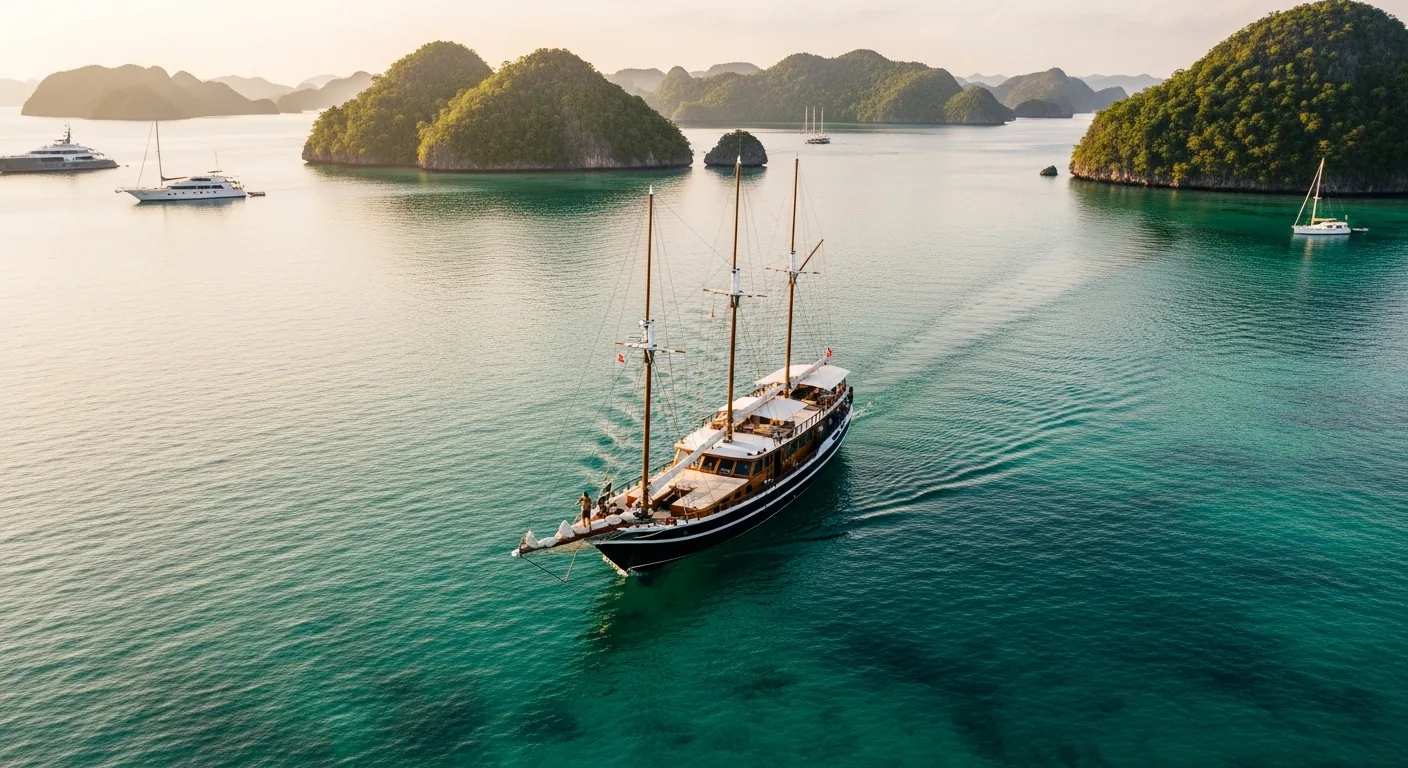
The first light breaks across the Wayag Lagoon, casting long shadows from the limestone karsts that rise vertically from a placid, turquoise sea. From the deck of a private yacht, the only sound is the gentle lapping of water against the hull and the distant call of a Papuan hornbill. This is the central promise of Raja Ampat: a direct, unmediated connection to one of the planet’s last true marine frontiers. Yet, planning an expedition to this remote archipelago, located off the northwest tip of Bird’s Head Peninsula in West Papua, presents a critical question: what is the real cost of access? The choice between a traditional Indonesian Phinisi and a contemporary motoryacht is not merely aesthetic; it is a fundamental decision that dictates the budget, pace, and texture of your entire expedition. See also: book Dive Sites Cape Kri Dampier.
Understanding the financial commitment for a Raja Ampat yacht charter can be opaque. Base charter fees, provisioning allowances, and operational expenses create a complex financial picture. This guide dissects the costs associated with both vessel types, providing clarity for discerning travelers, divers, and families looking to navigate these waters. We will examine specific vessels, sample budgets, and expert perspectives to illuminate the investment required for a private charter in this biodiversity hotspot, home to over 1,600 species of fish and 75% of the world’s known coral species.
Decoding the Raja Ampat Charter Invoice: What’s Included?
Before comparing vessel types, it is essential to understand the standard components of a charter agreement in this region. Unlike an all-inclusive resort stay, a private Raja Ampat charter yacht operates on a structure that separates the vessel hire from the operational expenses. This provides transparency and customization but requires careful budget planning. Most agreements, particularly for larger vessels, are based on MYBA (The Worldwide Yachting Association) terms, which typically segment costs into two primary areas: the Base Charter Fee and the Advanced Provisioning Allowance (APA).
The Base Charter Fee constitutes the primary cost and covers the hire of the yacht itself, complete with its crew, for the agreed-upon period. This fee also includes the crew’s salaries, their food, and the vessel’s insurance. What it does not cover are the variable expenses unique to your charter. This is where the APA comes in. The APA is a supplementary fund, typically calculated as 25-30% of the base fee, paid in advance. It acts as a running expense account managed by the captain on your behalf. At the end of the charter, the captain provides a detailed breakdown of expenditures, and any remaining funds are returned to you. Conversely, if expenses exceed the APA, the balance is payable before disembarkation. See also: book Home.
- Base Charter Fee: Covers the yacht, crew, and vessel insurance. This is the fixed price for the vessel’s time.
- Advanced Provisioning Allowance (APA): A variable fund covering fuel, food, beverages, port fees, laundry, and any special requests. A typical APA for a Raja Ampat boat charter is 30% due to higher fuel and provisioning logistics in this remote area.
- Taxes: Indonesian VAT (currently 11%) is often applied to the base charter fee.
- Crew Gratuity: While discretionary, a gratuity of 10-15% of the base fee is customary for excellent service and is paid directly to the captain at the conclusion of the trip.
- Park & Port Fees: Specific to the itinerary, this includes the mandatory Raja Ampat Marine Park Entry Permit, which costs IDR 1,000,000 (approximately $65 USD) per person and is valid for 12 months.
The Phinisi Experience: Heritage Sailing and Pricing Structures
The Phinisi is the iconic vessel of the Indonesian archipelago. These two-masted wooden schooners, hand-built by the Konjo boat-builders of South Sulawesi using centuries-old techniques, offer an authentic and romantic mode of exploration. Their broad beams provide expansive deck space and remarkable stability at anchor. While they are sailing vessels, the often-calm conditions within Raja Ampat’s islands mean they frequently operate under motor, consuming significantly less fuel than a motoryacht of comparable size. The experience aboard a Phinisi is one of connection to the sea, characterized by silent passages under sail when winds permit and a slower, more deliberate pace of discovery. See also: Yacht Charter Raja Ampat About.
Pricing for a Phinisi charter varies widely based on size, age, and level of luxury. A high-end Raja Ampat yacht hire on a vessel like the 51-meter Dunia Baru, which accommodates 14 guests in seven opulent cabins, starts from approximately $119,000 USD per week, plus APA. This vessel was constructed over eight years using locally sourced tropical ironwood. At the pinnacle of the market, the 55-meter Phinisi superyacht Prana by Atzaró, with nine suites for up to 18 guests and amenities including a yoga deck and cinema, commands rates from $125,000 USD per week. More accessible, yet still luxurious, options exist. Vessels like the 46-meter Mutiara Laut, accommodating 14 guests, can be chartered from around $87,500 USD per week. The value proposition of a Phinisi lies in its combination of cultural authenticity, generous space, and lower fuel consumption, making it an excellent choice for groups focused on diving, relaxation, and immersive exploration.
Motoryacht & Superyacht Charters: Speed, Luxury, and Cost Analysis
For travelers who prioritize speed, modern amenities, and the ability to cover vast distances efficiently, a motoryacht is the superior choice. A motoryacht can traverse the 180 kilometers from Sorong to the Wayag islands significantly faster than a Phinisi, allowing for more ambitious itineraries or more time spent at key locations. These vessels often feature advanced technology such as zero-speed stabilizers, which minimize roll while at anchor—a considerable comfort in open-water anchorages. Onboard amenities frequently surpass those on Phinisis, with features like jacuzzis, climate-controlled interiors, and extensive water toy collections being standard. See also: Contact.
The cost of a motoryacht charter reflects these advantages, primarily driven by higher acquisition costs and substantially greater fuel consumption. A modern motoryacht might consume 400-600 liters of fuel per hour while cruising at 15 knots, compared to a Phinisi’s 80-120 liters per hour at a more sedate 8 knots. The 60-meter expedition yacht Aqua Blu, a converted British Naval Survey vessel, offers 15 suites for up to 30 guests and is one of the most prominent motoryachts available for a Raja Ampat yacht charter. Its weekly rates start at $266,000 USD, plus APA. For smaller groups, the 34-meter The Devocean accommodates nine guests and charters from approximately $70,000 USD per week. The decision to charter a motoryacht is an investment in efficiency, comfort, and capability, particularly suited for guests with limited time or those wishing to explore the farthest reaches of the 4.6 million-hectare Raja Ampat archipelago.
Comparative Cost Breakdown: A 7-Night Dampier Strait Itinerary
To illustrate the financial differences, let’s model a hypothetical 7-night, 8-day charter for 10 guests exploring the Dampier Strait, home to world-renowned dive sites like Cape Kri and Blue Magic. Dr. Gerald R. Allen famously recorded 374 fish species on a single dive at Cape Kri, a testament to the area’s incredible marine density. The itinerary covers approximately 250 nautical miles, starting and ending in Sorong.
The table below provides an estimated cost comparison between a luxury Phinisi and a comparable motoryacht. These figures are illustrative and can vary based on the specific vessel, season, and provisioning choices. The fuel cost is a major differentiator; we assume diesel fuel costs approximately $1.50 USD per liter in this remote region.
| Cost Component | Luxury Phinisi (e.g., 45m, 12 guests) | Expedition Motoryacht (e.g., 40m, 12 guests) |
|---|---|---|
| Base Charter Fee (7 nights) | $90,000 | $110,000 |
| Estimated Fuel Consumption (250nm) | ~2,500 Liters (~$3,750) | ~8,000 Liters (~$12,000) |
| Food & Beverages (10 guests) | $10,000 | $12,500 |
| Park & Port Fees (10 guests) | $800 | $800 |
| Subtotal (Estimated APA Usage) | $14,550 | $25,300 |
| Recommended APA (30% of Base) | $27,000 | $33,000 |
| Indonesian VAT (11% on Base) | $9,900 | $12,100 |
| Total Estimated Cost (Excluding Gratuity) | $126,900 | $155,100 |
This comparison highlights that while the motoryacht’s base fee is only moderately higher, its operational costs, driven by fuel, create a significant difference in the total expenditure. The final choice depends on whether the value of speed and onboard systems outweighs the higher operational budget and the romantic appeal of a traditional Raja Ampat charter yacht.
Beyond the Base Rate: Factoring in Relocation Fees and Seasonal Premiums
The transparent pricing of a charter agreement can still hold nuances that affect the final cost. One critical factor is the yacht’s location. Many of the finest vessels in Indonesia split their time between Raja Ampat (October-April) and Komodo National Park (May-September). If you request a Raja Ampat boat charter outside the typical season, or if the yacht is not already in the region, you may be liable for relocation fees. These fees cover the cost of fuel and crew time to move the vessel from its current location, for example, from Labuan Bajo to Sorong, a journey of over 1,000 nautical miles that can take several days and cost upwards of $20,000-$50,000 USD depending on the vessel.
Furthermore, demand during peak periods like Christmas and New Year’s (late December to early January) often incurs a holiday surcharge. This premium can range from 10% to 20% on top of the base charter fee. Booking well in advance—ideally 9 to 12 months—is not only crucial for securing your preferred vessel but also for avoiding these surcharges and ensuring the yacht is positioned correctly for your itinerary without incurring substantial relocation costs. A knowledgeable charter broker will clarify the vessel’s schedule and any potential ancillary fees before you commit, ensuring no financial surprises arise during your expedition planning.
Expert Insights: When to Choose a Phinisi or a Motoryacht
Making the right choice extends beyond the balance sheet. It’s about matching the vessel to the intention of your travel. We asked charter specialist Jean-Marc Ghestin, with over two decades of experience in Indonesian waters, for his perspective. “The Phinisi is for the journey,” he explains. “It’s for the guest who wants to feel the archipelago, to have a expansive platform for diving and dining, and who measures the trip in experiences, not nautical miles per hour. For multi-generational families, the sheer deck space is a private resort.” He notes that for dedicated dive groups planning to spend most of their time exploring the rich coral gardens of the Dampier Strait or Misool, a Phinisi’s slower pace is not a hindrance but part of the immersive experience.
Conversely, “the motoryacht is for the destination,” Ghestin continues. “If a guest has only ten days and their absolute priority is to photograph the karst formations of Wayag and also dive the southern reefs of Misool, a motoryacht is the only practical tool. Its speed turns a challenging logistical feat into a seamless itinerary.” The stability offered by modern motoryachts is another key factor for guests who may be sensitive to motion at sea. For those seeking the highest level of privacy and technological comfort, or for corporate charters where time is a critical commodity, the efficiency and amenities of a motoryacht justify the premium investment. The best Raja Ampat yacht hire is one where the vessel’s characteristics are in perfect alignment with the traveler’s priorities.
Planning Your Raja Ampat Yacht Charter: Next Steps
Navigating the costs and options for a private charter in Raja Ampat requires expert guidance. The first step is to define the parameters of your expedition. Answering these questions will provide a clear brief for your charter broker, enabling them to present the most suitable vessels and a precise, preliminary budget.
- Who is traveling? Determine your group size and composition (e.g., couples, families with young children, a dedicated dive group). This dictates the required cabin configuration.
- When do you want to travel? The optimal season for Raja Ampat is from October to April, offering the calmest seas and driest weather. Be specific about your date range.
- What is your primary focus? Are you intent on intensive diving, leisurely snorkeling and kayaking, land excursions to see the Red Bird of Paradise, or simply relaxing in remote anchorages?
- What is your approximate budget? Having a clear understanding of your all-in budget (including APA, taxes, and gratuity) allows your broker to filter the available fleet effectively.
With this information, you can begin a productive conversation. A detailed proposal for a yacht charter Raja Ampat will include several vessel options, sample itineraries, and a transparent estimate of all associated costs. The journey to the world’s most biodiverse marine ecosystem begins with this crucial planning phase. To receive a curated selection of yachts and a personalized quote for your expedition, contact our specialists.
Contact Us to Plan Your Raja Ampat Expedition
Our team has extensive, first-hand knowledge of the vessels and cruising grounds of Raja Ampat. We are ready to assist you in crafting a seamless and exceptional private charter experience.
Brand: Yacht Charter Raja Ampat
Phone: +6281-1394-14563
Email: bd@juaraholding.com
Office: Jalan Sunset Road No. 88, Kuta, Badung, Bali 80361, Indonesia